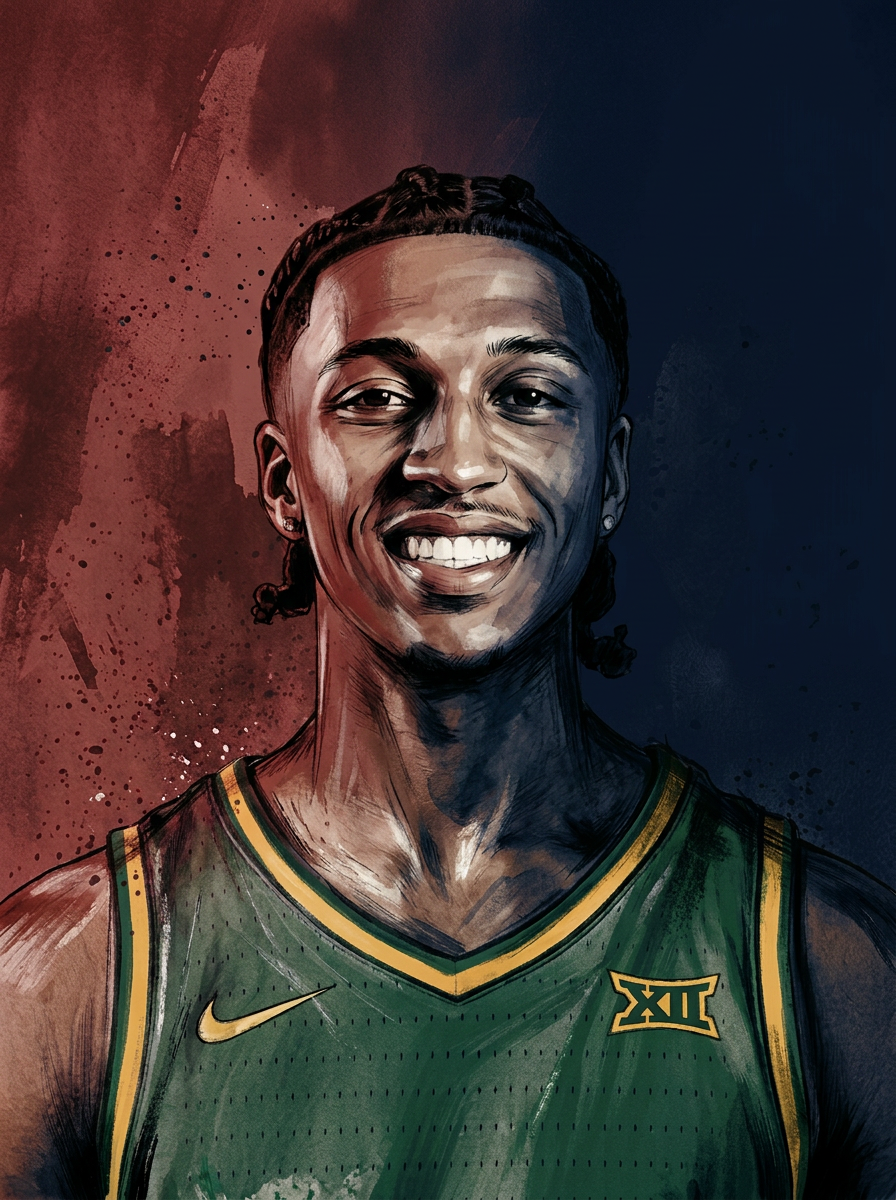
Cameron Carr
Cameron Carr is the Baylor wing who came out of nowhere after a redshirt — leading the Bears at 19 a game on 39% from three with the kind of vertical pop most shooters don't have. Movement-three reps off pin-downs and DHOs, finishes above the rim on closeout attacks, and a 1.3 BPG mark for a 6'5" guard that scouts can't stop pointing at. He's not a primary creator yet and the frame is thin. For Detroit at #21 he's the bullseye fit — movement shooting and length on the wing is the loudest hole on this roster.
Combine intel pending. Measurements, workout reports, and team interviews land here as they break.
Per-36 Stats
Baylor · static profile seed
Best NBA comp for Cameron Carr?
Disagree? Cast your vote. One per browser. 0 votes so far.

- Cade5/5
- Ausar5/5
- Duren5/5
- Grit4/5
Bullseye fit. Movement shooting + length on the wing is Detroit's #1 roster need.
If Carr is on the board at 21, this is the pick. He answers Detroit's loudest need — shooting and length around Cade — and he does it without needing the ball: movement-shooting off Cade screens, lob threat on baseline cuts, and second-jumps for putbacks. The defensive bonus is the part nobody else in this tier offers — a 6'5"/7'0.75" wingspan guard who actually generates events. Floor is a Cam Johnson-style movement shooter who plays 25 minutes on a contender; ceiling is the Mikal Bridges-light defensive version if the frame catches up.
The Report
Carr is the breakout name of the season at Baylor. After two non-factor years at Tennessee (18 games, 2.3 ppg) and a redshirt, the transfer-portal move unlocked the version of him that was on the high-school radar as a top-60 RSCI recruit out of Link Academy. He's leading the Bears at 18.9 / 5.8 / 2.6 on 49/39/_ splits, with a 60.8% TS, and he's doing it as the focal point of the offense rather than a complementary piece.
The carrying skills are movement shooting and vertical pop. 39.1% from three on real volume, comfortable off pin-downs and DHOs, with a quick release that beats closeouts. The vertical-pop layer is what separates him from every other shooter in this tier — he's a credible lob threat on cuts, attacks closeouts in two dribbles for finishes above the rim, and second-jumps for putbacks at a rate guards aren't supposed to. The 5.8 RPG and 1.3 BPG on a 6'5" guard are both top-of-class outliers.
Defensively the 7'0.75" wingspan plus the vertical timing combine into a genuine wing-stopper foundation. The shot-blocking (1.3 BPG, ~5% BLK% for a guard) is the rarest part of the profile — Floor and Ceiling explicitly compares the off-ball event creation to a thinner Mikal Bridges. He's reactive more than disruptive in 1-on-1 yet and gets bullied by stronger guards, but the tools for switchability are there.
The two real flags are creation off the dribble and frame. He's a single-read processor in pick-and-roll right now — comfortable as a relocation shooter and connector but not a half-court engine. The 175–190-lb frame depending on listing is the most physically underdeveloped player in this draft tier, and the rim finishing through NBA contact is the obvious follow-on concern.
For Detroit at 21, this is the cleanest 'fit + upside' wing on the board. Movement shooting + length is the loudest roster need around Cade, and the lob/cut version means he doesn't have to dribble for the offense to score. Floor outcome is Cam Johnson-style movement shooter who plays 25 minutes on a contender; swing is the Bridges-light defensive version if the strength catches up.
- ▸Movement shooter at 39.1% from three on Baylor's #1-option volume — pin-downs, DHOs, quick release vs. closeouts
- ▸Vertical pop separates him from every other shooter in this tier — lob threat on cuts, attacks closeouts to finishes above the rim
- ▸Top-of-class shot-blocking for a guard — 1.3 BPG / ~5% BLK% on a 6'5" wing is genuinely rare
- ▸5.8 RPG for a guard — second-jump and timing-based, not just opportunistic
- ▸7'0.75" wingspan + vertical timing — credible switchability foundation onto 1–3
- ▸60.8% TS as a primary scorer — efficient on real volume, not just a low-usage shooter
- ▸Improving event-creation profile — Floor and Ceiling's Mikal Bridges (less defense) comp
- ▸Underdeveloped frame (listed 175–190) — most physically underdone player in this draft tier
- ▸Single-read processor off the bounce — 2.6 APG to 2.4 TOV, not a half-court engine
- ▸Rim finishing through NBA contact is a real concern at his weight
- ▸Defensive ceiling capped by strength vs. NBA wings until the frame fills out
- ▸Two lost years at Tennessee before the redshirt — only one real season of production
- ▸Self-creation off the dribble lags — leans on cuts, transition, and second jumps to manufacture offense
If Carr is on the board at 21, this is the pick.
If underdeveloped frame never resolves, underdeveloped frame (listed 175–190) — most physically underdone player in this draft tier
He answers the open questions below — film, role, and reps between now and June.
Three Questions
Does the frame add 15-20 lb of functional strength without losing the vertical pop that makes the profile work?· debate →
Is the half-court self-creation salvageable into a secondary-creator role, or does he stay a relocation shooter + cutter for life?· debate →
Can the shot-blocking translate into NBA wing-stopper minutes — or is it a half-court novelty that disappears against pro athletes?· debate →
See the room argue it out
Open the Draft Room debateWhere Scouts Disagree
No public split on Cameron Carr yet — the scouting community is mostly aligned (or hasn't weighed in loudly enough for us to call it a real debate).
We'll log the divide here as soon as the takes start splitting.
Start the debate in the Draft Room →Movement-shooting is the carrying NBA skill and it's already finished. 39.1% from three on Baylor's #1-option volume, comfortable off pin-downs and DHOs, quick release that beats closeouts. The off-ball gravity translates day one even if nothing else does
- Vertical pop is the second skill that separates him from every other shooter in this tier — lob threat on cuts, takes closeouts to above-rim finishes in two dribbles, and second-jumps for putbacks at a rate guards aren't supposed to. The 5.8 RPG / 1.3 BPG on a 6'5" guard are both top-of-class outliers and they show up on tape as repeated highlight plays.
- Defensive profile is where the tier separation happens. 7'0.75" wingspan + vertical timing produces real shot-blocking (1.3 BPG, ~5% BLK%) — Floor and Ceiling explicitly comps the off-ball event creation to a less-defensive Mikal Bridges. He's reactive more than disruptive on the ball but the foundation for a switchable wing is there.
- Frame is the obvious red flag — listed 175–190 depending on the source, gets bumped through contact at the rim, and the strength deficit caps the on-ball defense vs. NBA wings. The development arc on functional strength is the entire swing on whether the Bridges-light outcome lands.
- Self-creation off the bounce is the second cap — 2.6 APG / 2.4 TOV as a single-read processor. He's a relocation shooter + cutter at the next level, not a half-court engine. That's fine in Detroit's archetype need but it does close the door on a secondary-creator outcome unless the handle and processing develop late.
Consensus
Each outlet's evaluation of the player's pure value, ignoring team fit. Bars scale inversely to rank.
Got intel or a question on Cameron Carr?
Drop a tip, a film note, or a scouting question — we'll work the best ones into the next Intel Report.
Get the Pistons Draft Intel Report
Want our deeper film notes on Cameron Carr and the rest of the #21 board? Get the first Pistons Draft Intel Report the moment it ships.
Keep digging on Cameron Carr
Detroit-first ranking with Fit Scores.
Our latest first-round projection through pick #30.
Curated head-to-head with verdict and Detroit angle.